



La deuda técnica es el impuesto invisible al crecimiento de cualquier producto digital. Al principio permite lanzar rápido y validar el mercado, pero cuando ese atajo se convierte en norma, cada nueva funcionalidad tarda más, cuesta más y genera más riesgo.

The answer is rarely a lack of talent. More often, it lies in the accumulated friction within the product: rigid architecture, fragile integrations, inconsistent design decisions, and processes that can no longer support the speed the business needs. IBM defines this reality as the future cost of relying on shortcuts or suboptimal decisions made during development.

The good news is that, when properly managed, technical debt can stop being a blocker and once again turn product, design, and technology into engines of growth.

What Is Technical Debt and Why Is It a Risk for Your Business?

Technical debt is the accumulation of technology, architecture, data, or process decisions that were useful at the beginning but now hold back the evolution of the product.

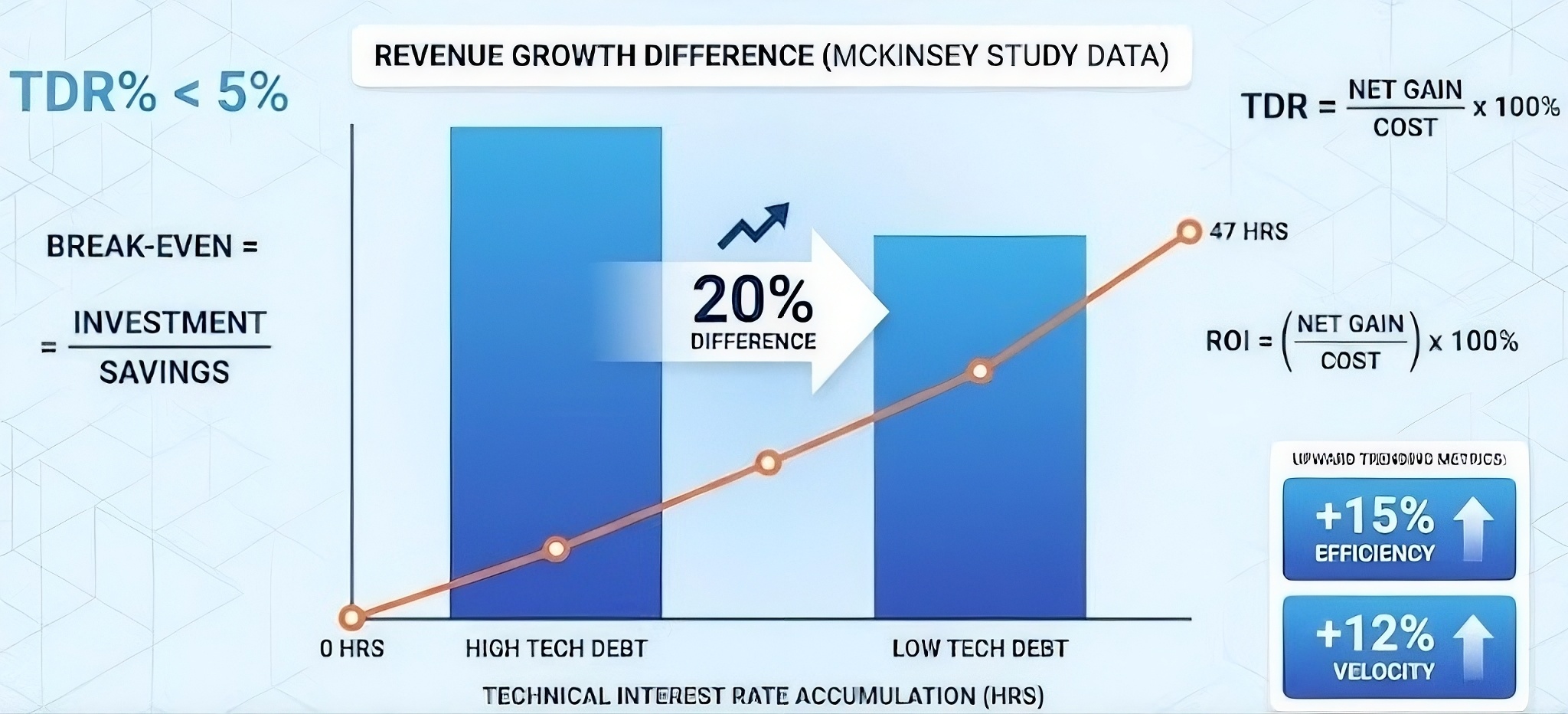
McKinsey estimates that between 20% and 40% of the value of many companies’ technology stack is already compromised by technical debt, and that a significant portion of the budget allocated to innovation ends up being diverted to address its consequences.

Impact of technical debt on revenue growth. Adapted from McKinsey & Company data. Source: https://byteiota.com/technical-debt-roi-how-mckinseys-20-data-wins/?utm_source

At Creative Coefficient, we understand that at certain stages of a business, “borrowing” time is a valid strategic decision, especially when validating an MVP or exploring a new market. The problem is not taking on debt; it is allowing the interest to consume your competitive agility. When that happens, every new feature costs more, takes longer, and creates greater risk.

The Real Impact of Technical Debt on Design and User Experience (UX)

One of the most common mistakes is thinking that technical debt only affects the development team. In reality, it directly limits the ability of product design to innovate. When the infrastructure is weak:

  • Complex flows cannot be iterated.
  • Personalization becomes expensive.
  • A/B tests take weeks.
  • The omnichannel experience becomes inconsistent.
  • New interfaces depend on legacy systems that are nearly impossible to adapt.

The result is simple: users lose trust, friction increases, and conversion drops.

Common Causes: Why Has Your Product Lost Agility?

As mentioned above, loss of agility is often the result of quick decisions that worked at the beginning but now limit the product’s ability to evolve.

Fast Launches Without a Long-Term Vision

  • Fragile dependencies.
  • Poorly modeled databases.
  • Duplicated logic.
  • Lack of robust testing.

Lack of a Strategic Tech Partner

Many companies delegate product development to vendors that only deliver code, without taking responsibility for the future health of the digital asset. The risk is clear: software is built without business architecture. Without a clear vision for product, scalability, and experience, the system grows in layers rather than by design.

Rigid Architectures That Block Growth

IBM identifies architectural debt as one of the biggest barriers to scalability and maintainability. Legacy systems often prevent companies from:

  • Integrating new APIs.
  • Connecting AI tools.
  • Adding automations.
  • Evolving toward multichannel experiences.
  • Supporting new business models.

How to Identify Whether Technical Debt Is Holding Back Your Scalability

This checklist helps Product Owners, CEOs, and CPOs detect early warning signs:

  • Slow time-to-market: launching a small improvement takes months.
  • Constant regressions: fixing one bug causes two new issues.
  • Unachievable roadmap: strategic features are postponed sprint after sprint.
  • Dependency on key people: only one or two profiles “understand” critical parts of the system.
  • Slow onboarding: new team members take too long to start adding value.
  • Increasing maintenance costs: every release requires more QA, support, and rework.
  • Design constrained by the backend: UX is simplified because of technical limitations.
  • Difficulty attracting talent: strong professionals do not want to work with outdated stacks.
  • Decline in experimentation: the team avoids innovating out of fear of breaking production.
  • Customer loss due to UX friction: slowness, errors, and inconsistent journeys affect conversion.

When several of these signs appear together, we are no longer talking about a technical problem. We are talking about a direct risk to business scalability.

How Creative Coefficient Helps You Restore the Health of Your Digital Asset

En Creative Coefficient, we help transform products blocked by debt into platforms ready to grow. The goal is not to find “mistakes,” but to identify the friction points that are limiting growth.

Architecture Audit

We carry out an in-depth evaluation of:

  • Stack health.
  • Scalability.
  • Design debt.
  • Integration risks.
  • Delivery bottlenecks.
  • Business and conversion impact.

Strategic Refactoring

This is not about rebuilding the website or app from scratch. It is about optimizing the pieces that generate the greatest return: critical modules, data layers, the design system, key APIs, CI/CD automation, observability, and testing.

Quality Culture

Debt does not disappear on its own. Real change happens when design and development adopt processes that prevent new debt: solid design systems, evolutionary architecture, quality gates, living documentation, technical ownership, complexity metrics, and delivery metrics.

Turn Your Technology Into a Competitive Advantage

Technical debt is an asset that must be managed with business criteria. When governed properly, it unlocks speed, improves UX, and turns technology into a real competitive advantage. A healthy digital product does not just reduce costs; it allows you to scale, innovate, and lead your category.

If your roadmap is currently moving more slowly than the market demands, it is time to review the true health of your product. Book a strategic session with Creative Coefficient and discover how design, architecture, and technology can once again drive your business growth.

Frequently Asked Questions About Technical Debt:

What is the difference between technical debt and an obsolete product?

Technical debt is the accumulated cost of past decisions that continue to penalize the product’s evolution. Obsolescence, on the other hand, refers to a lack of adaptation to the market, the user, or the available technology. A product may not be commercially obsolete and still suffer from critical debt.

How does technical debt affect my company’s ROI?

Technical debt impacts ROI in two ways:

  • Direct cost: more hours spent on maintenance, bugs, and rework.
  • Opportunity cost: features that are not launched on time, lower conversion due to poor UX, and customer loss to more agile competitors.

When is the right time to address technical debt?

The right time to address technical debt comes when maintaining the product costs more than innovating on top of it. If every new initiative takes longer, creates more risk, or requires more resources than before, you are already paying too much interest.